
Why tiles crack and lift in Maltese apartments
Tiles rarely fail because the tile was bad. They fail because a sun-baked run had nowhere to expand, the screed under them was the wrong thickness or system, or the adhesive class did not match porcelain or an exterior deck. Here is how to tell which, and what a repair realistically involves.
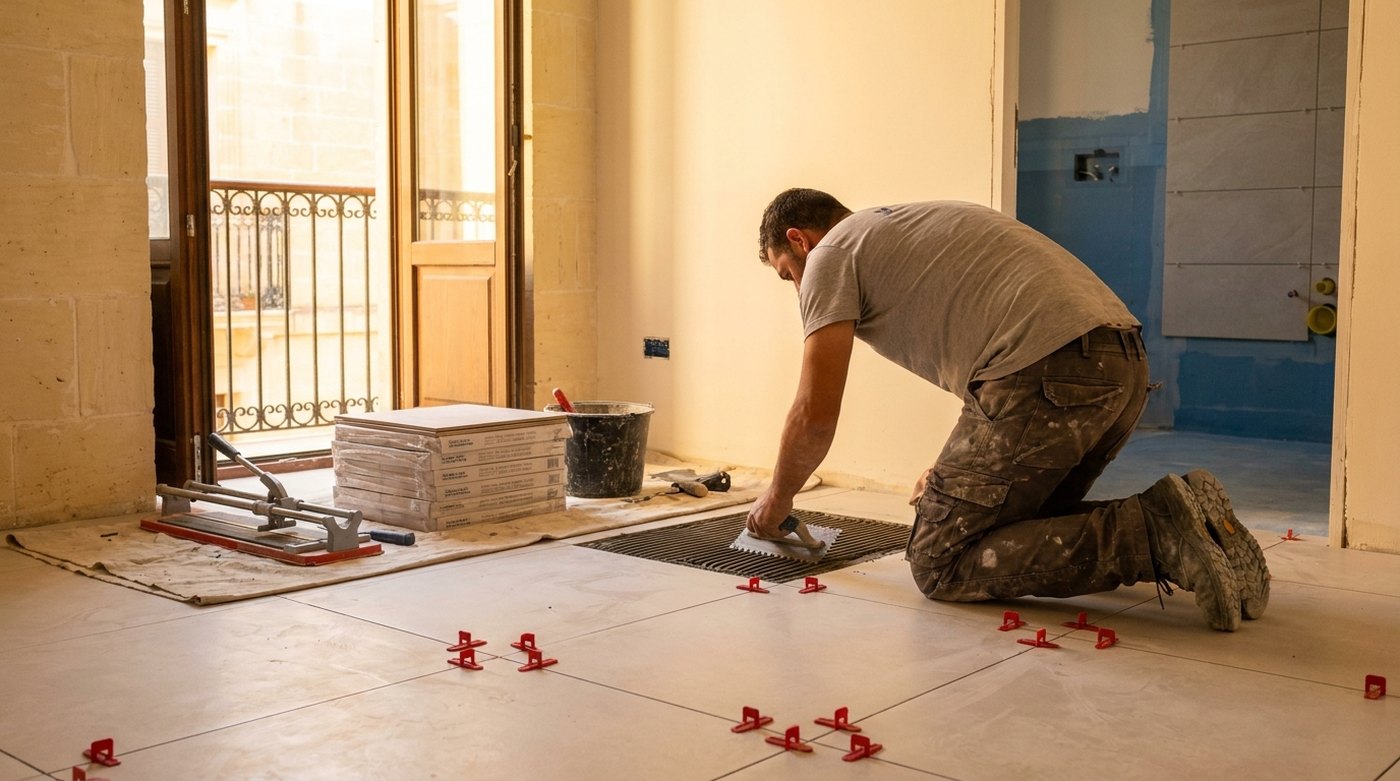
Tiles are the most inspected surface in a Maltese flat and the least understood. A buyer will spend an hour choosing a finish and ten seconds asking what goes underneath. When something fails a year later — a ridge across a terrace, a hollow note under the heel in a hallway, a hairline crack running through four tiles in a straight line — the tile gets blamed. The tile is almost never the problem.
Three causes account for most of it in Malta: no movement joints on long runs in the sun, the wrong screed, and an adhesive class that does not match the tile or the exposure. They produce different symptoms and they need different repairs, so it is worth learning to tell them apart before anyone quotes you.
Culprit one: the run had nowhere to grow
Ceramic and porcelain expand with heat at roughly 6 to 8 micrometres per metre per degree Celsius. That sounds like nothing. Run the arithmetic over a real terrace and it stops sounding like nothing.
Take a 10 metre run. Assume a 40 °C difference between a February night and the surface of a dark tile in July — that swing is an assumption, not a published Maltese figure, and no source in this set measures local surface temperatures. At 6 µm/m/°C the run wants to grow 2.4 mm. At 8 µm/m/°C it wants 3.2 mm.
Now ask where those three millimetres go. If the field is tiled hard up against a wall, a threshold, a column or a parapet, with grout in every joint and no compressible gap anywhere, they go nowhere. The guide to expansion joints puts it plainly: tension builds until the edge of a tile gives way. That is the failure you see as tenting along a line, as crushed and chipped tile edges against a wall, or as a crack that runs straight across several tiles rather than wandering.
The fix is designed in, not added later. It has two parts:
- Perimeter joints — a compressible gap where the tiled field meets every restraint: walls, columns, thresholds, kerbs, upstands. Skirting or a sealant bead covers it. It must not be filled with rigid grout or mortar.
- Intermediate movement joints — joints dividing a large field into smaller ones. The expansion-joint guide sets out field sizes; what it does not give is a Malta-specific maximum for a terrace in full sun, and nobody else publishes one either. What you can insist on is that your tiler states the field size he is working to and shows you where the joints will fall, before he sets out.
Exterior areas, long corridors and anything over an unheated void are where this bites. Interiors shaded from direct sun move less, but a perimeter joint costs nothing to leave and everything to retrofit.
Culprit two: the screed
Most British arrivals expect a timber floor and are surprised to find a concrete slab with a sand-cement screed on top. The screed is what makes the floor flat and what carries the tile. If it is too thin for its system, it cracks, and the crack telegraphs straight through the tile above it.
Maltese practice bands screed thickness from around 40 mm up to 100 mm and above, depending on the system used. That is a wide band because it covers different situations — screed bonded to the slab behaves differently from screed floating over insulation or services, and the thickness has to suit. The number on its own tells you nothing. What matters is that the person laying it knows which system he is building and lays it to the thickness that system requires.
In shell-form purchases this is your decision, not the developer's. The shell comes with a structural slab and nothing else, so the screed specification is written by whoever you hire. Ask for the system and the thickness in the quote. If a quote says "screed" with no thickness and no system, you have no way to check what you got once the tiles are down.
Symptoms of screed failure: hollow-sounding tiles over an area rather than along a line; cracks that reappear in the same place after a repair; and movement you can feel underfoot near a crack.
Culprit three: the adhesive class
Adhesive is classified, and the classification is the only thing on the bag that matters. Two letters do most of the work.
| Marking | What it means | When you need it |
|---|---|---|
| C2 | Improved cementitious adhesive | Porcelain, which is dense and absorbs almost nothing |
| S1 | Deformable adhesive | Exterior work, heated floors, substrates that deform |
The standards insight paper points to C2 for porcelain and to S1 flexible adhesives for exterior, heated and deformable substrates. A terrace in large-format porcelain therefore wants both: C2 S1. An interior bathroom wall in porcelain may only need the C2 part.
This is where cost-cutting hides, because a basic adhesive and a C2 S1 adhesive look identical once they are under the tile. The only moment you can verify it is on site, with the bags in front of you. Photograph the bags. That is not distrust; it is the only record that will exist.
There is no trade licence for tilers in Malta, so the specification in your quote and the bags on your floor are the enforcement mechanism. Third-party verification schemes are a filter on who turns up, not a substitute for writing the classes down.
Terraces, flat roofs and the flood test
Under any tiled area that gets wet, there is a waterproofing membrane, and it must be tested before the tiles go on. A flood test before tiling is the standard step: fill, hold, check below, then tile. It is an hour of inconvenience against the alternative.
The alternative has a published number. Water-damage repairs in Malta run from €1,000 to €3,000 and above. That is the cost of finding out late — because once the tiles and screed are on top of a failed membrane, reaching the membrane means removing everything above it.
In an apartment block, a roof or a common terrace is typically a common part and falls under the condominium regime in Cap. 398, which means the works are not yours to authorise alone. None of the sources here interprets who decides or who pays, so treat that as a question for the administrator and the deed before you book anyone. In Gozo, add the ferry to every delivery of membrane, screed and adhesive; it affects scheduling more than price.
The repair economics, honestly
Our own pricing model, like the calculator on the homepage, works per square metre of tiled surface. That has an uncomfortable implication for repairs: the cost tracks the area disturbed, not the number of broken tiles.
Cutting out and replacing a handful of tiles is the cheap outcome, and it is the right one when the cause was an impact, the surrounding field rings solid and the adhesive class was correct. Two things spoil it. First, matching — no source publishes how long Maltese importers hold a batch, and colour and calibre drift between batches, so an invisible repair is a matter of luck. Second, and more seriously, a spot repair puts a new tile back into the same conditions that broke the last one. If the cause was a missing perimeter joint, the ridge returns on the same line.
Lifting a field is the expensive outcome and sometimes the only honest one: when the screed is cracking through, when the adhesive is the wrong class across the whole area, or when the membrane beneath has failed. It means removing the tiles, usually the screed, re-forming the waterproofing, flood testing it, re-screeding to the right thickness, and tiling with movement joints set out from the start. No source in this set publishes a Maltese rate for that work, or for cutting retrofitted movement joints into an existing field, so anyone quoting you should be quoting from measurement rather than from a published figure.
The practical conclusion: pay for the diagnosis before you pay for the tiles. A tiler who tells you which of the three causes he thinks it is, and why, is giving you the only information that determines whether you are spending a little or a lot.
Common questions
- What does C2 S1 actually mean on a bag of adhesive?
- They are two separate parts of the same classification. C2 means an improved cementitious adhesive — the class the standards insight paper points to for porcelain, which is dense and absorbs almost nothing, so the bond has to come from the adhesive rather than from suction into the tile. S1 means a deformable adhesive, the grade indicated for exterior work, heated floors and substrates that move. A bag marked C2 S1 satisfies both. For an interior wall in fully vitrified porcelain you may only need the C2 part; for a terrace you need both.
- My tiles lifted in a ridge along one line. Is that damp?
- More often it is compression. Tiles expand roughly 6 to 8 micrometres per metre per degree Celsius, so a long run in direct sun grows measurably, and if there is no movement joint or perimeter gap the tension builds until the edge of a tile gives way. That failure shows up as a ridge or tenting along a line, or as chipped and crushed tile edges, rather than as isolated hollow tiles. Damp failures tend to look different: staining, efflorescence, and hollowness spreading from a wet edge.
- Should the screed be tested before the tiles go down?
- On anything that gets wet, the waterproofing under the screed should be flood tested before tiling, not after. Once tiles are bedded on top, a failed membrane can only be reached by demolishing everything above it, and published Maltese water-damage repair costs run from €1,000 to €3,000 and above.
- Can a few cracked tiles just be swapped out?
- Sometimes. If the surrounding field is sound, the adhesive is the right class and the cause was a one-off impact, individual tiles can be cut out and replaced. If the cause was missing movement joints or a failing screed, replacing tiles puts new tiles into the same conditions that broke the old ones, and the failure returns along the same line. The diagnosis, not the tile count, decides whether a spot repair is honest.
What we could not establish
- The expansion-joint guide sets out field sizes between movement joints, but no source publishes a Malta-specific maximum field dimension for exterior terraces, nor measured surface temperatures for Maltese roofs and decks. The temperature swing used in the arithmetic below is an assumption, clearly labelled as one.
- No source gives a Maltese rate for spot tile replacement, for lifting and relaying a field, or for cutting in retrofitted movement joints. The only repair figure any source publishes is for water damage.
- Nothing in the sources covers tile availability — whether importers hold batches long enough for a matching replacement years later, or what to do when a discontinued tile cannot be matched.
- No source establishes screed curing or drying times before tiling, nor how Maltese humidity affects them.
- No source addresses grout class, joint width or maximum tile format, all of which interact with movement.
- No source in this set interprets Cap. 398 on who authorises and pays for waterproofing works to a common-part roof or terrace, or what majority is required.
Sources
- Tile expansion joints: complete guide — tilesamples.eu · read 2026-09-21
- How Thick Should Screed Be — Kibitec Ltd · read 2026-09-21
- Tile adhesive standards insight paper — Wacker Chemie · read 2026-09-21
- How To Waterproof Screed In Malta — Kibitec Ltd · read 2026-09-21
- Waterproofing Malta — Lazarus Turnkey — Lazarus Turnkey · read 2026-09-21
Want this costed properly?
The calculator gives you a figure in a minute. A site visit gives you a fixed price.
Book a free survey