
Terrace and roof tiling in Malta: waterproofing first
On a Maltese flat roof or terrace, the tile is the wearing surface and the membrane underneath is the actual waterproofing. This is what the build-up involves, who pays for a roof that is a condominium common part, and where a Development Notification comes into it.
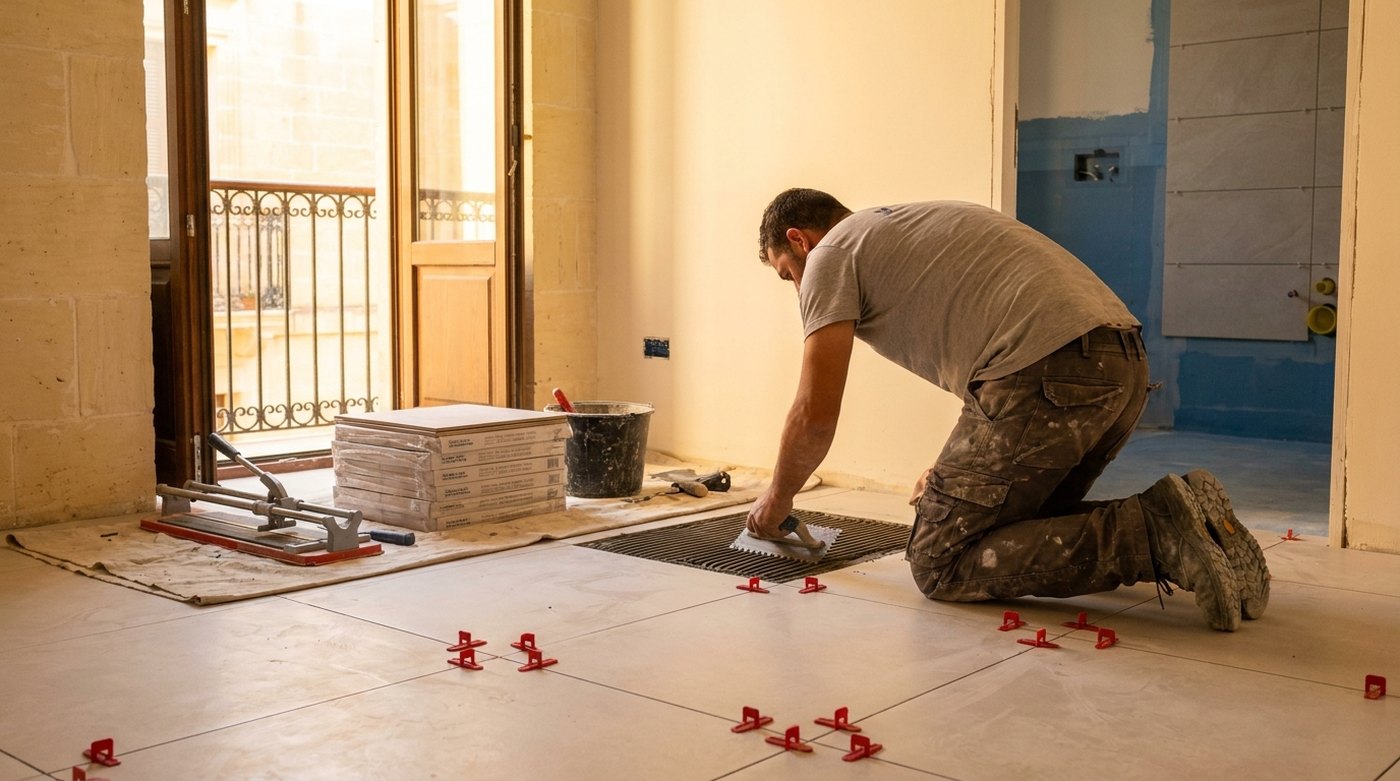
This is the single most useful thing to understand before you spend money on a terrace in Malta. The tiles you choose, and the per-m² rate you get for laying them, cover the wearing surface — the bit you walk on and look at. The thing that keeps water out of the apartment below is a membrane buried under the tiles, and it is invisible the day the job finishes and for several years afterwards.
That matters because of the failure sequence. A membrane that was rushed, badly lapped or laid over a dirty deck does not leak on day one. It leaks in the third or fourth winter, at which point the only way to reach it is to lift every tile above it. The tiling is the cheap part of that repair.
British and other arrivals often come from a context of pitched roofs and tiles that shed water by gravity. A Maltese flat roof or terrace does not shed water; it holds it briefly and then drains it. The build-up has to be watertight, not merely water-shedding.
Torch-on bitumen: what the guarantees actually say
The dominant documented system for Maltese flat roofs is bituminous membrane, applied with a torch. WP Ltd, a waterproofing contractor based in Qormi, lists bituminous APP and SBS membranes and publishes guarantees of 10 to 20 years, with a stated service life of 20 to 30 years. Its service list also covers what Maltese builders call appoggi.
Lazarus Turnkey's waterproofing page is more specific about specification: it describes torch-on SBS in two layers as the best option for flat roofs. Two layers is not a luxury. It means the laps in the second layer sit away from the laps in the first, so a single weak seam is not a single route into the building.
Liquid systems are also sold in Malta. None of the sources used here publishes guarantees or service life for them, so this article cannot compare the two honestly on numbers. If a contractor proposes a liquid system, ask for the guarantee in writing and compare it against the 10–20 years that bituminous work is publicly guaranteed for.
The flood test is the checkpoint
Lazarus Turnkey states that a flood test is carried out before tiling. This is the moment in the programme that protects you, and it is the moment most likely to be skipped when a job is running late.
The logic is simple: plug the outlets, fill the roof with water, leave it, and look at the ceilings below. A membrane that fails this test costs a morning to fix. The same membrane, discovered failing after tiles are bedded on it, costs the whole finish.
Two practical points follow. First, agree in writing that the flood test happens and that you or your perit are told the result before any adhesive goes down. Second, accept that this adds days to the programme — the roof has to be flooded, held, drained and dried. A tiler who can start "tomorrow" on a roof that was membraned today is telling you something.
Falls, outlets and movement joints
Water has to reach a drain. On a terrace that means the surface is laid to a fall, and the fall has to be set before tiling, not corrected afterwards by varying adhesive thickness. None of the sources here publishes a minimum gradient or a maximum spacing between outlets for Maltese terraces, which is a genuine gap — it is a question for the perit on your job.
Movement joints are better documented. Guidance on tile expansion joints sets out that outdoor tiled fields should not exceed roughly 25 m², with individual sides of about 5 to 6 m, and that the joints must be filled with an elastic material rather than rigid grout. Malta makes this non-negotiable in practice: a dark exterior tile in July and the same tile in January are not the same size, and a rigid field with nowhere to move lifts, tents or cracks along a line.
So a 6 m × 8 m terrace is not one tiled field. It is at least two, with a real joint between them, and that joint will be visible. Deciding where it falls is a design decision — along a step, a threshold, a change of pattern — and it is worth making deliberately rather than leaving it to whoever is laying tiles that morning.
Tiles: what the market supplies
Maltese suppliers stock exterior floor ranges in a 2 cm format. BigMat Malta at Ta' Qali sells 2 cm stone exterior floor tiles priced per piece, which works out at approximately €25 to €54 per m² depending on the range — a figure derived from the per-piece prices, not a published per-m² rate.
Note two things. The per-piece pricing convention means you must convert before comparing tiles, and your comparison has to include waste and cuts, which rise sharply where the terrace is irregular or where falls meet parapets at awkward angles. And the sources do not state a minimum required tile thickness outdoors — 2 cm is what the market supplies, not a rule we can cite.
Who pays: the roof as a condominium common part
If your terrace is the roof of a block of flats, cost is not simply a matter of who uses it.
As Mamo TCV Advocates set out, the Condominium Act (Cap. 398, articles 11 and 12) allocates roof maintenance 50% to the owner of the top-floor unit the roof covers, and 50% between the remaining owners. That split is the default, and it surprises people in both directions: top-floor owners who assumed the block would pay for the roof over their heads, and ground-floor owners who assumed a terrace they never set foot on was none of their business.
Practical consequences for a re-waterproofing job:
- Get the scope and the quotation to the administrator before work is instructed, not after. A bill presented to co-owners retroactively is an argument.
- Separate the sums. Waterproofing is roof maintenance. A decorative tile upgrade chosen by the top-floor owner is a different kind of spend, and the sources here do not establish how such an upgrade is apportioned — that is a question for a lawyer on the specific title deeds.
- Keep the membrane guarantee document in the condominium's records. A 10–20 year guarantee is worth nothing if nobody can find it in year eight.
Permits: where a DN comes in
A Development Notification (DN) is a Planning Authority procedure introduced by Legal Notice 211 of 2016, with a submission fee of €60, as reported by the Kamra tal-Periti. The Authority has revised its processes so that DNs can also be submitted in respect of regularised properties, which matters if your block was regularised.
What these sources do not establish is the schedule of works a DN covers. So the honest position is this: re-waterproofing and re-tiling an existing terrace may need nothing, but anything that changes the roof — raising parapets, a pergola, new structure, altered levels — belongs in front of a perit before you commit. The €60 fee is trivial next to the cost of an enforcement problem on a roof you have just finished.
Sequencing, trades and verification
Waterproofing and tiling are usually two different trades with two different guarantees, and the interface between them is where responsibility gets lost. Be explicit about who owns the membrane, who owns the falls, and who is liable if the tiler's fixings, mechanical anchors or drainage details puncture somebody else's work.
Malta has no trade licence for tilers, so there is no register to check and no qualification a tiler must hold. That is why third-party verification — CheckYourTraders in our case — and a written membrane guarantee do the work that licensing would do elsewhere. Ask for both, in paper, before deposit.
If the property is in Gozo, every pallet of 2 cm tiles and every roll of membrane crosses on the ferry, so material lead times and the flood-test window need planning around delivery days rather than assumed to be same-week.
Finally, on cost: the calculator on this site prices tiling per m² of tiled surface. Waterproofing is not in that figure, and no source we rely on publishes a €/m² rate for membrane work in Malta — so treat the membrane as a separately quoted item and get it quoted before you fall in love with a tile.
Common questions
- How long does a torch-on bituminous roof membrane last in Malta?
- WP Ltd, a Qormi waterproofing contractor, publishes guarantees of 10 to 20 years on bituminous APP/SBS membranes and states a service life of 20 to 30 years. The guarantee period and the expected life are two different things, and the guarantee is the one you can hold somebody to.
- Who pays when the roof of a block of flats needs waterproofing?
- Under the Condominium Act (Cap. 398), as set out by Mamo TCV Advocates, roof maintenance is split 50% to the owner of the top-floor unit that the roof covers and 50% between the remaining owners. Articles 11 and 12 of the Act govern this, and it applies whether or not the top-floor owner has exclusive use of the terrace.
- Do I need a permit to re-waterproof and re-tile my terrace?
- There is no single answer in the published sources. A Development Notification (DN) is a Planning Authority procedure introduced by Legal Notice 211 of 2016, with a €60 submission fee, and the Authority has revised its processes so that DNs can also be submitted for regularised properties. The sources used here do not list which works fall within the DN schedule, so the only reliable step is to ask a perit before work starts.
- Why are exterior tiles in Malta 2 cm thick?
- Maltese suppliers stock exterior floor ranges in a 2 cm format — BigMat Malta at Ta' Qali sells 2 cm stone exterior floor tiles by the piece, which works out at roughly €25 to €54 per m² depending on the range. The sources do not state a minimum required thickness for external tiling, so treat 2 cm as what the market supplies rather than as a rule.
What we could not establish
- No source here publishes a minimum fall (gradient) for a Maltese terrace or flat roof towards its outlets, nor a maximum distance between outlets.
- Liquid-applied waterproofing systems are widely offered in Malta, but none of these sources publishes guarantee periods, expected service life or comparative performance for them, so they cannot be compared with torch-on bitumen on published figures.
- WP Ltd's service list uses the Maltese term 'appoggi' without defining it or stating what the work includes, and no source here sets out the traditional Maltese roof build-up in layers.
- No source publishes a €/m² rate for waterproofing works in Malta, so membrane cost cannot be quoted alongside the per-m² tiling rates on this site.
- The sources do not state whether a new membrane can be bonded over an existing one, or when full strip-back to the deck is required.
- The DN schedule — the list of works that a Development Notification actually covers — is not established by these sources.
- No source here addresses ferry scheduling or delivery surcharges for materials going to Gozo.
Sources
- Services — WP Ltd — WP Ltd (Qormi) · read 2026-09-21
- Waterproofing Malta — Lazarus Turnkey — Lazarus Turnkey · read 2026-09-21
- The Maintenance of Roofs, Floors & Ceilings under Maltese Law — Mamo TCV Advocates · read 2026-09-21
- Floor Tiles Exterior — BigMat Malta — BigMat Malta (Ta' Qali) · read 2026-09-21
- Tile expansion joints: complete guide — tilesamples.eu · read 2026-09-21
- PA revises its processes to allow the submission of DNs — Kamra tal-Periti · read 2026-09-21
Want this costed properly?
The calculator gives you a figure in a minute. A site visit gives you a fixed price.
Book a free survey