
Can you tile over existing tiles in Malta?
Tiling over sound, well-bonded old tiles can save a strip-out, but only with real surface preparation, a flexible polymer-modified adhesive and the old movement joints carried through. It is not an option for pools, and it does not fix a leaking shower.
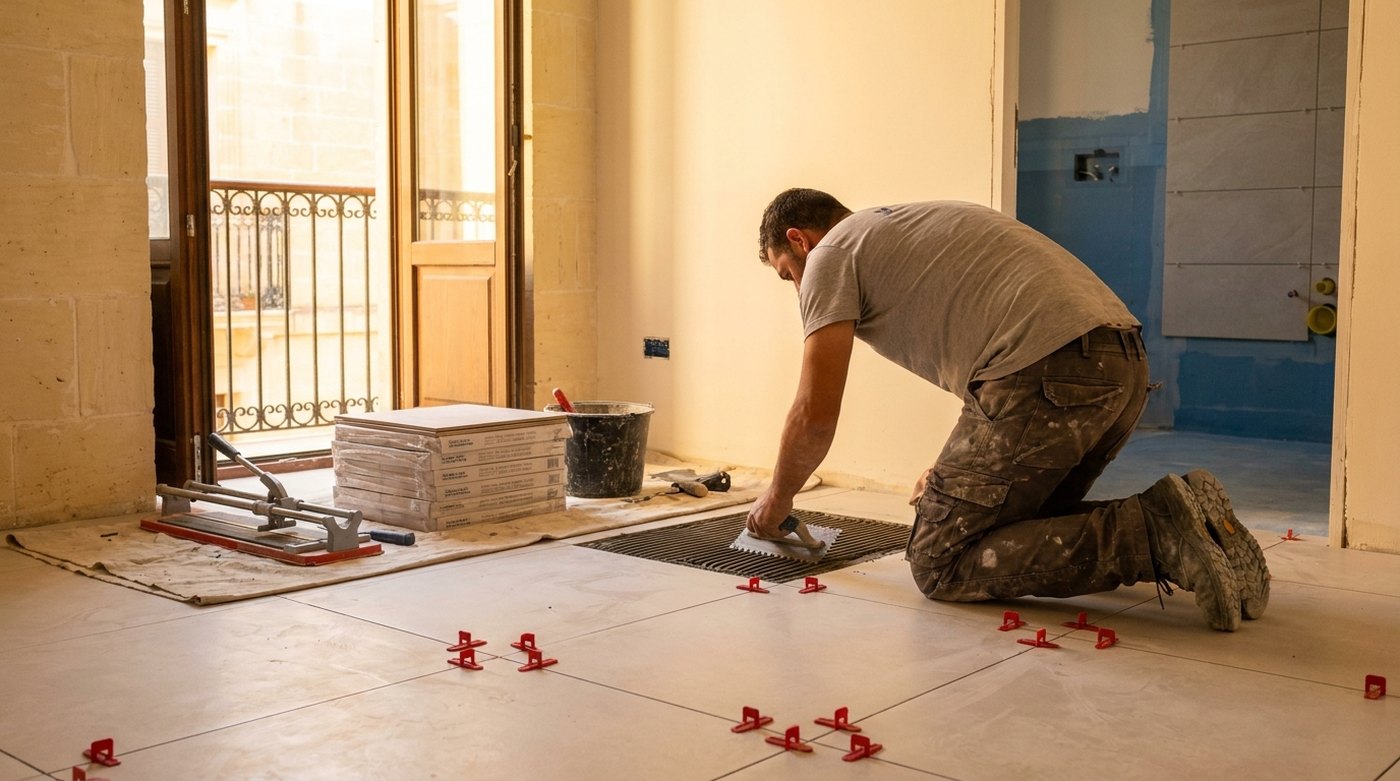
The question comes up on almost every refurbishment: the bathroom is tiled floor to ceiling in something from 1998, the kitchen floor is sound but dated, and the owner wants to know whether the new tiles can simply go on top. The honest answer is that it is sometimes possible indoors, under conditions that are more demanding than people expect, and that it is flatly excluded in a few places where it is most often asked about.
Everything technical below comes from two manufacturer documents: ARDEX's Technical Bulletin TB117, dated 17 April 2020, written for Australia and New Zealand, and an insight paper from Wacker Chemie AG on EN 12004 adhesive classes. There is no Maltese rule on this. No local authority, standard or licensing body publishes guidance on tiling over existing tiles, and there is no trade licence for tilers in Malta, so nothing external checks which adhesive went into your bathroom. The manufacturers' conditions are the only conditions there are.
When the old tiles are a substrate and when they are rubbish
TB117 starts with soundness. The existing tiles must be sound, with no loose or drummy tiles anywhere in the area. "Drummy" is the hollow note you get when you tap a tile that has lost its bond — it is still in place, still grouted, and carrying nothing. Tap the whole floor or wall with a knuckle or a coin before anyone quotes. One drummy tile is not a localised problem: it tells you the original installation was not at full adhesive coverage, and the rest of the area is suspect.
The bulletin also requires 100% adhesive coverage on both faces — the original bed under the old tile, and the new bed you are about to lay. That is the point most tile-over-tile failures turn on. Spot-fixing or dot-and-dab under the new layer leaves voids that flex, and the two layers together are heavier than the substrate was designed to hold.
Preparation: degrease or grind
A glazed tile is a deliberately non-absorbent, low-friction surface. Nothing bonds to it reliably as it stands. TB117 gives two preparation routes:
- Wash with a degreaser. This option is specified for internal applications only.
- Grind off at least 80% of the glaze, then prime. This is the mechanical route, and it is dusty, slow work.
Which one applies is a judgement about the tile, the room and what the new layer has to carry. Neither is a formality, and neither appears as a priced line on any Maltese rate card, including ours — see the gaps above.
The adhesive is where tile-over-tile gets expensive
ARDEX requires the second adhesive to be a polymer-modified type, not a basic cement adhesive. Wacker's paper fills in what that means under EN 12004. A C1 adhesive reaches at least 0.5 MPa adhesion and is not for tiles over 30 × 30 cm. A C2 reaches at least 1 MPa and is described as suitable for almost any substrate, old tiles included, with formats up to 60 × 60 cm for a standard C2.
Flexibility is a separate axis. Wacker describes S1 flexible adhesives as mandatory for very-low-absorption porcelain, for larger formats such as 30 × 60 cm, and for critical substrates — a category that explicitly includes floor heating and tile-over-tile. S2 highly flexible adhesives are for very large tiles. The paper's summary of tile-on-tile is worth repeating: it saves time, but it is demanding for the adhesive, and a C2 is the typical choice.
So the saving on labour is partly spent on the bag. These are the prices listed by Iperceramica in Msida, reproduced as published:
| Product | Price |
|---|---|
| Kerakoll Pragma Flex 25 kg | €14.30 |
| Kerakoll H40 No Limits 25 kg | €24.75 |
| Mapei Ultralite S1 Flex Zero 15 kg | €36.29 |
| Kerakoll H40 Revolution 25 kg | €39.93 grey / €41.31 white |
| Kerakoll H40 Extreme 10 kg | €63.14 |
The listing does not show EN 12004 classes. The only product that declares S1 does so in its name. If you are buying the adhesive yourself, ask for the class in writing rather than assuming it from the price. In Gozo, add the ferry to every delivery of it.
The three places the answer is simply no
- Pools and ponds. TB117 excludes them. A permanently immersed surface does not get a second layer.
- A leaking shower. The bulletin states that a new layer of tiles in a shower will not cure a leak. The water has already found a route past the tiled surface; adding tile and adhesive above it changes nothing about that route.
- Heavy and large-format tiles on walls. These should not be considered safe over existing tiles, because both layers then load the substrate. This matters in Malta more than in northern Europe, because bathrooms here are routinely tiled floor to ceiling, so a wall tile-over-tile is a large area of doubled weight, not a splashback.
Movement joints and flatness
Movement joints in the old layer must be carried through the new one. If the existing floor has a joint at a doorway, around a perimeter or across a long run, the new tiling needs a joint in the same position — not a continuous grout line over the top of it. A joint that gets buried stops working, and the stress it was absorbing goes into the tiles instead.
TB117 also notes that large formats may need a smoothing coat first to achieve flatness. An old floor that was acceptable under 300 mm tiles can be out of tolerance under 600 mm or 1200 mm ones, because a long tile bridges hollows that a short one followed. That is the point at which tile-over-tile starts to cost what a strip-out would have.
Weighing it against the strip-out
The Tiler.mt rate card bands strip-out of existing tiles at €10–18 per m² of tiled surface, covering removal, bagging and disposal, with making good extra where render comes away. That last clause is the real variable in Maltese flats: tiles bedded hard into render often take the render with them, and the wall then needs re-rendering before anything goes back on it. Avoiding that uncertainty is the strongest argument for tiling over.
Against it, the laying rates do not change — ceramic / porcelain at €35–58 per m², large-format porcelain at €55–85 per m² — while the adhesive specification goes up, preparation is added, and a smoothing coat may appear. The rate card's floor levelling compound band is deliberately null: it is quoted on site, because it depends on how far out the slab is, and no Maltese source publishes a figure for it.
In an apartment, there is a second consideration. Works that touch common parts, and the noise and debris of a strip-out, fall under the condominium rules in Cap. 398. Tiling over keeps a strip-out's skips and dust out of the block — a genuine practical advantage, but not a technical one. It does not make an unsound floor sound.
How to decide in ten minutes
Tap the whole area for drummy tiles. Check for a leak if it is a shower. Rule it out entirely if it is a pool. Check whether the new tiles are large format, and whether they are going on a wall. If the old layer is sound, the room is internal, the format is modest and the budget allows an S1 adhesive and proper preparation, tiling over is a legitimate method with a manufacturer's bulletin behind it. If any one of those fails, the €10–18 per m² strip-out is the cheaper decision, taken earlier.
Common questions
- Will a new layer of tiles stop my shower leaking?
- No. ARDEX's bulletin states plainly that a new layer of tiles in a shower will not cure a leak. The water is getting past the tiled surface somewhere — a failed waterproofing membrane, a joint, a penetration — and burying that under a second layer of tile and adhesive hides the symptom while the water keeps moving. A leaking shower needs stripping back to the substrate and re-waterproofing.
- Can I tile over the tiles in my pool to change the colour?
- No. TB117 excludes pools and ponds from tile-over-tile applications entirely. Permanently immersed surfaces are a strip-out job.
- Which adhesive do I need for tiling over old tiles?
- Not a basic cement adhesive. ARDEX requires the second adhesive to be a polymer-modified type. Wacker's insight paper puts tile-over-tile among the critical substrates for which S1 flexible adhesives are described as mandatory, alongside floor heating, very-low-absorption porcelain and larger formats such as 30 × 60 cm. A C2 adhesive — at least 1 MPa adhesion under EN 12004, suitable for almost any substrate including old tiles — is the typical starting point, with S1 flexibility on top of that.
- Does tiling over tiles always save money?
- It saves the strip-out, which the Tiler.mt rate card bands at €10–18 per m² of tiled surface, plus the making-good that follows when render comes away with the old tiles. Against that you spend more on adhesive, and you may need a smoothing coat before large formats. Nobody in Malta publishes a per-m² price for grinding glaze or for a levelling compound, so the saving can only be confirmed by a quote on the actual room.
- Can I tile over tiles on a wall?
- Sometimes, but weight decides it. ARDEX states that heavy and large-format tiles over existing tiles should not be considered safe on walls, because both layers then load the substrate. Light ceramic over light ceramic on a sound, well-bonded wall is a different proposition from large-format porcelain over an old wall of unknown build-up.
What we could not establish
- No Maltese source publishes a price for tile-on-tile surface preparation — degreasing, grinding the glaze or priming. It is not a line on the Tiler.mt rate card.
- The Tiler.mt rate card carries 'Floor levelling compound' with a null band — quoted on site, because it depends on how far out the slab is. There is no published figure to plan around.
- The technical guidance here is from adhesive manufacturers — ARDEX in Australia and New Zealand, Wacker in Germany. There is no Maltese standard, code or published rule on tiling over existing tiles that these sources establish.
- The sources say nothing about tiling over existing tiles on external terraces and flat roofs, beyond the fact that the degreaser preparation route is specified as internal only. Waterproofing under tiles is outside everything cited here.
- The Iperceramica listing does not show EN 12004 classes for the products it sells, except where the class appears in the product name. A buyer standing in the shop cannot read C2 or S1 off the shelf price list.
- No source establishes how much height a second tile layer adds, or what that does to door undercuts, thresholds and shower falls in a Maltese flat.
Sources
- Technical Bulletin TB117: Applications of tiles onto pre-existing tiles — ARDEX Australia / New Zealand (manufacturer technical bulletin) · read 2026-10-05
- Insight paper: Tile adhesive standards and their relevance for tile installation — Wacker Chemie AG · read 2026-10-05
- Glue for tiles — Iperceramica (Msida) · read 2026-10-05
- Tiler.mt rate card — Tiler.mt (first-party) · read 2026-10-05
Drafted with Claude — claude-opus-5, then read, corrected and approved by Neil Bennett before publication. We do not publish anything a person has not read.
Want this costed properly?
The calculator gives you a figure in a minute. A site visit gives you a fixed price.
Book a free survey