
Keeping and restoring traditional Maltese tiles
Original patterned cement tiles (madum) are unfired, microporous and intolerant of acid. Here is what they are made of, how a restorer cleans and seals them, who still presses new ones by hand, and the prices nobody in Malta publishes.
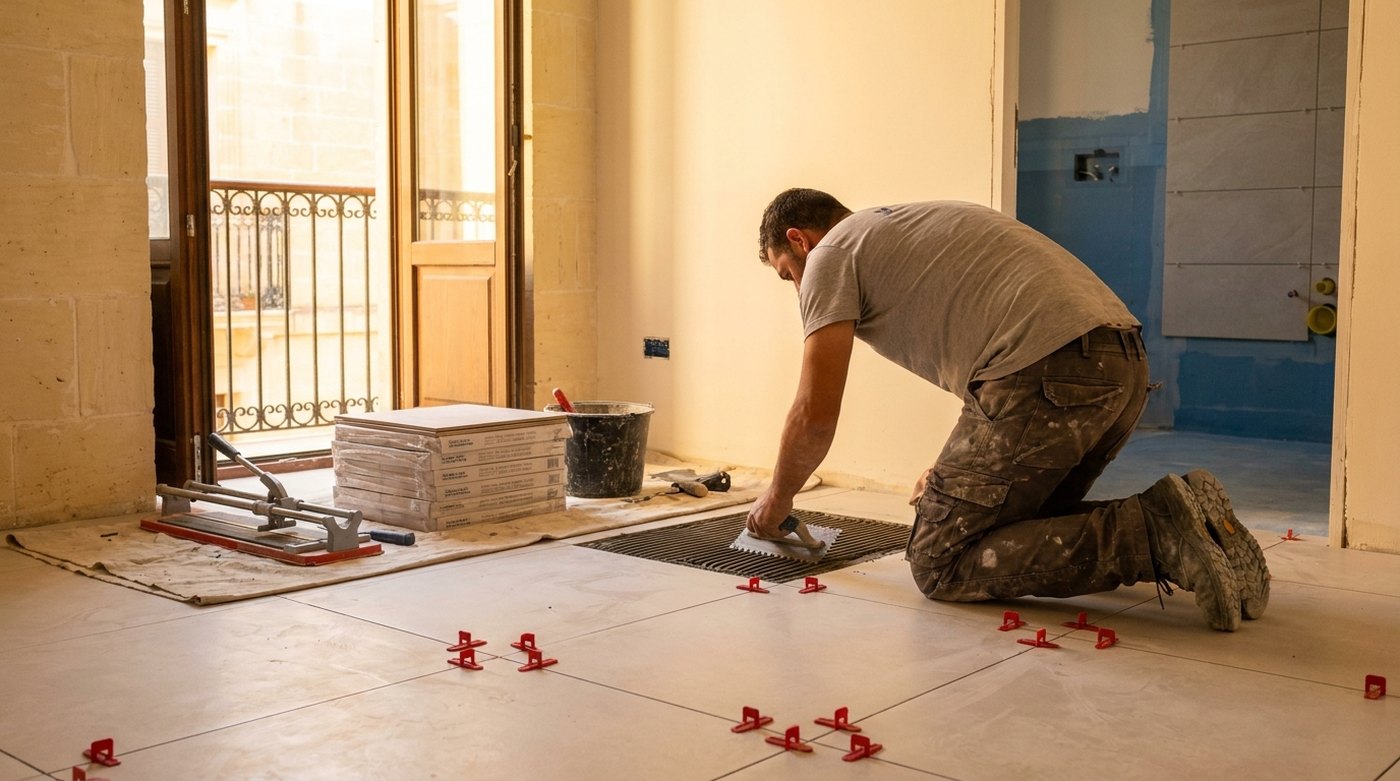
Patterned cement tiles — madum — are the floor most people are buying when they buy a townhouse or a house of character. They are also the floor most likely to be ruined in the first fortnight of ownership, usually by somebody with a bottle of something acidic and good intentions. This article covers what the tiles actually are, why that makes them fragile in a specific and predictable way, what a restorer does to them, and where you can still buy new ones made by hand.
What the tile is made of
A Maltese cement tile is not fired. It is pressed. GuideMeMalta describes three layers, laid into the mould in order and compressed together:
- Il-mastig — the face. Marble dust, white cement and pigment. Historically sea sand was used in place of marble dust. This is the layer that carries the pattern, and it is only a few millimetres thick.
- Il-putraxx — a middle layer of fine sand and black cement.
- Il-mirange — the back, coarser sand and black cement.
The tiles are 20 × 20 cm, pressed by hand and then placed in water. The Snop House gives the same process from the other end: cement, marble powder, natural pigments and sand, compacted in a hydraulic press, never fired, cured by air drying and immersion in water, with the pattern formed by a compartmented metal divider mould. The result has a matte finish, never a glaze.
Zanzi Homes names three of the maker's tools: il-plakka, the design mould; il-kwadru, the colour-setting tool; and it-tampun, the pressure plate.
Two things follow from this that matter more than anything else in the article. First, the pattern is a layer of coloured cement a few millimetres deep — it is not printed on and it is not infinitely deep either, so aggressive abrasion takes it off. Second, because the tile is cured rather than vitrified, FILA Solutions describes it as microporous and states that it must be sealed. An unsealed cement tile absorbs water, oil, wine and grout slurry. And because the binder is cement, acid dissolves it. This is the opposite of the ceramic and porcelain most arrivals from the UK are used to, where the glaze is chemically indifferent to almost anything in a kitchen cupboard.
Where they came from — the sources disagree
The Snop House gives a clean lineage: cement tiles originated in France around 1850, were shown at the 1867 Paris World's Fair, and reached Malta in the second half of the 19th century, where they became standard in townhouse corridors, reception rooms and staircases. GuideMeMalta's 2018 piece, by Kristina Cassar Dowling, instead claims an origin roughly 300 years ago with Ottoman roots.
These cannot both be right, and neither source shows its working. We present it as disputed. If you have been told your floor is "three hundred years old", treat that as a claim rather than a date. What is not in dispute is that corridors, reception rooms and staircases are where you find them, which is exactly where they are now at risk from renovation traffic.
Cleaning and sealing: what the technical guidance actually says
The only technical source here is FILA Solutions, an Italian manufacturer. It is a reference, not an endorsement — we are not naming or recommending their products. The sequence it sets out is:
- Seal before grouting. Apply a water-repellent protector to the tile face before grouting, so that grout pigment cannot stain the porous surface. This applies to newly laid tiles and to old tiles being relaid.
- Wash after laying with an alkaline detergent diluted 1:5, left on for 4–5 minutes, then rinsed.
- Seal properly. A water-based sealer is walkable after 4 hours. A solvent-based sealer covers roughly 5–15 m² per litre, depending on how porous the tile is — on a thirsty old floor, assume the bottom of that range.
- Maintain with a pH-neutral cleaner. Never acidic, never bleach-based.
That last line is the one to write on the wall. Limescale removers, descalers, toilet cleaners, most "heavy duty" bathroom sprays and anything advertised for cement residue will etch the face of a cement tile. So will bleach. The coverage figure is also worth noting if you are costing materials yourself: a long corridor of absorbent nineteenth-century tile consumes considerably more sealer per square metre than a modern floor.
Who still makes them
GuideMeMalta reports Malta Tiles Ltd, run by Robert Lia, with the company formed in 2017, continuing the work of Joe Camilleri, who retired around 2012. A separate GuideMeMalta article names Colombo in San Gwann and Hal Mann as makers producing handmade cement tiles in the traditional way. Zanzi Homes, writing as an estate agency, says few tile makers remain in Malta, and that existing traditional tiles can add value to a property because buyers appreciate them. The 2018 article also notes that reclaimed tiles carry extra appeal.
What none of the sources establishes is whether a workshop will press a run to match an existing pattern in your house, what the minimum order is, or the lead time. That is a phone call, not a published fact. If you are in Gozo, add a ferry crossing to every delivery of tiles and of sealer.
What this costs, and what nobody publishes
Our own rate card is a per-m²-of-tiled-surface model. The relevant band is Patterned / decorative: 55–92 € per m², made up of labour 30–42 € and tile 25–50 €. That band covers encaustic, hexagon and herringbone — it is a material choice, not a quality tier, and it is the band for laying new decorative tiles, including new handmade cement tiles.
Replacing individual cracked or lifted tiles has no published band on our card. It is quoted per tile, on site, because the variables — whether a matching tile exists, what is under the one that lifted, whether the neighbours come up with it — are not knowable from a photograph.
And there is no line at all for restoring an old floor: cleaning, stripping decades of wax, sealing, or lifting and relaying salvaged tiles. That is not an omission on our part alone. No Maltese restorer we could find publishes a price per m² for any of it. If you are getting quotes, expect bespoke figures and expect them to differ widely between contractors; there is no reference rate to anchor against, which also means there is no number to point to when one quote is three times another.
Two Maltese constraints worth knowing
There is no trade licence for tilers in Malta. Anyone can present as one. For a modern floor that is a quality risk; for an irreplaceable nineteenth-century floor it is a different order of risk, because the mistake is permanent. Ask what cleaner and what sealer the contractor intends to use, and whether the sealer goes on before grouting. Those two answers tell you most of what you need to know.
If the tiles are on a shared staircase, they are probably not yours alone. In a converted townhouse or a block, the common parts — the entrance hall and the stairs, which is precisely where the best tiles usually are — fall under the condominium rules in Cap. 398. Works there are a condominium decision, not an individual owner's.
Finally, a genuine blank: none of the sources opened says whether an original tiled floor enjoys any protection under planning or heritage rules, or whether stripping one out of a scheduled property or an urban conservation area requires permission. If your property is scheduled or in a UCA, that question is worth putting to the planning authority before anything is lifted — we cannot answer it from what is published.
Common questions
- Can I use bleach or an acid-based cleaner on old Maltese tiles?
- No. FILA Solutions is explicit that acidic and bleach-based products must never be used on cement tiles. The face is cement, marble dust and pigment, not fired glaze, and acid attacks the cement binder itself. Routine cleaning should be with a pH-neutral cleaner.
- Can I still buy new tiles in the old patterns?
- Yes. GuideMeMalta reports Malta Tiles Ltd, run by Robert Lia and formed as a company in 2017, continuing the work of Joe Camilleri who retired around 2012; a second GuideMeMalta piece names Colombo in San Gwann and Hal Mann as makers still working in the traditional way. Zanzi Homes notes that few tile makers remain. None of the sources says whether a workshop can match a specific existing pattern, or what the minimum order is.
- What does it cost to clean, seal or relay an original floor?
- Nobody publishes a figure. No Maltese restorer we could find lists a price per m² for cleaning, sealing or relaying old cement tiles, and our own rate card has no line for it. Our card does carry a 'Patterned / decorative' band at 55–92 € per m² of tiled surface for laying new decorative tiles, and quotes replacement of individual cracked or lifted tiles on site, per tile.
- Do original tiles add value when selling?
- Zanzi Homes, an estate agency, says existing traditional tiles can add value because buyers appreciate them, and a second source notes that reclaimed tiles carry extra appeal. That is an agency view, not a valuation method, and none of the sources quantifies it.
What we could not establish
- No Maltese restorer or workshop publishes a price per m² for cleaning, sealing, lifting or relaying original cement tiles — the restoration side of this trade is quoted privately, floor by floor.
- The sources disagree on how long these tiles have been made in Malta: one dates cement tiles to France around 1850 and arrival in Malta in the second half of the 19th century; another claims roughly 300 years of local history with Ottoman roots. Neither cites evidence.
- No source opened says whether an original tiled floor is protected under Maltese planning or heritage rules, or whether removing one from a scheduled or urban-conservation-area property needs permission.
- No source gives a breakage or salvage rate for lifting old tiles, so nobody publishes how many tiles survive a lift.
- No source states how often a sealer needs reapplying in Maltese conditions, or how a sealed floor behaves under sustained foot traffic.
- No source addresses old cement tiles on terraces or roofs, or how they interact with waterproofing layers.
Sources
- Colourful, unique, versatile: how are traditional Maltese tiles made? — GuideMeMalta · read 2026-10-05
- Local quirks: a focus on Maltese tiles — GuideMeMalta · read 2026-10-05
- Cement Tiles in Malta: History, Craftsmanship and Decorative Heritage — The Snop House (Senglea) · read 2026-10-05
- A Timeless Classic – Traditional Maltese Tiles — Zanzi Homes · read 2026-10-05
- How to Clean Encaustic Tiles: Protection and Care Tips — FILA Solutions (manufacturer, Italy — technical reference, no prices) · read 2026-10-05
- Tiler.mt rate card — Tiler.mt (first-party) · read 2026-10-05
Drafted with Claude — claude-opus-5, then read, corrected and approved by Neil Bennett before publication. We do not publish anything a person has not read.
Want this costed properly?
The calculator gives you a figure in a minute. A site visit gives you a fixed price.
Book a free survey