
Large-format porcelain vs ceramic in a Maltese flat
Porcelain's low water absorption and slab formats make terrace-to-living-room continuity possible, but the specification tightens all the way down: C2 adhesive rather than C1, a flatter screed, and fixing labour that runs roughly double.
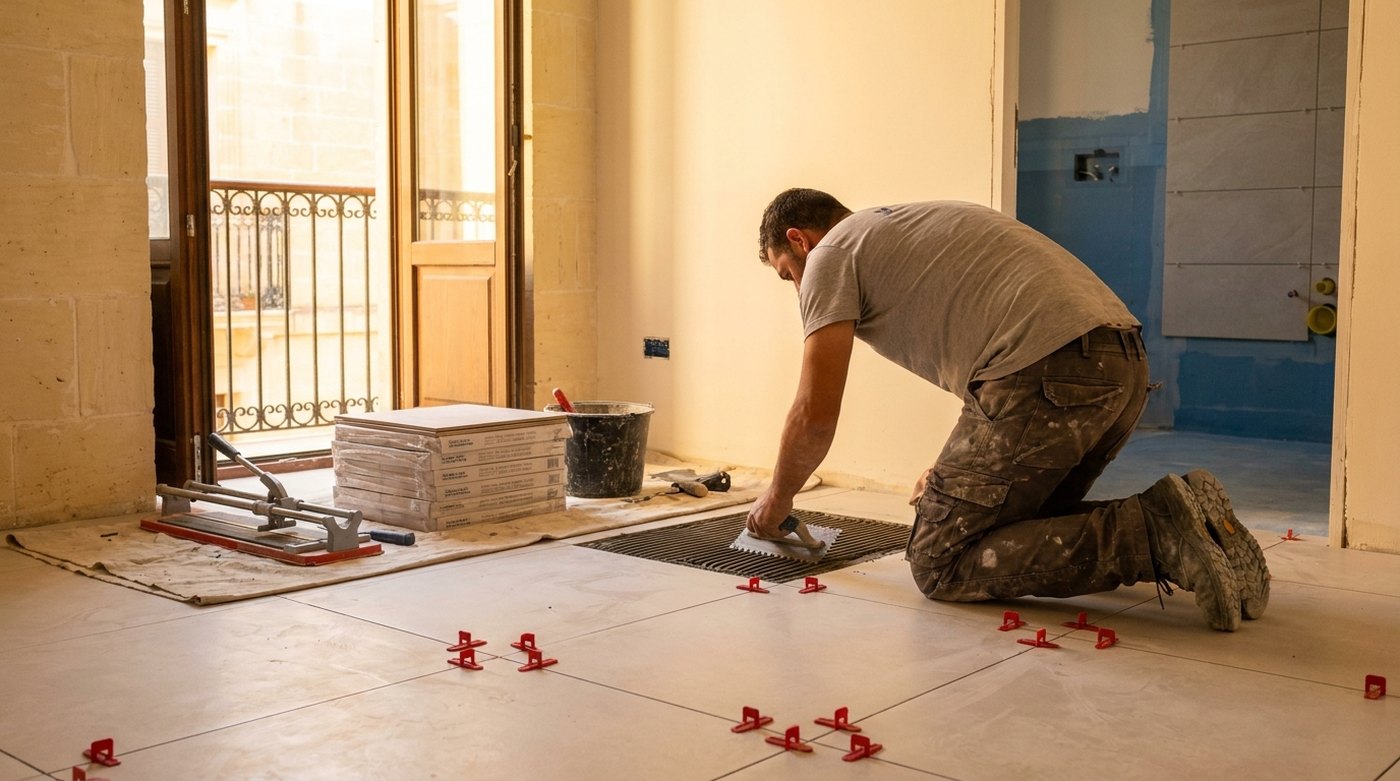
Most people arriving from the UK have tiled a bathroom and possibly a kitchen floor. In Malta, tiling is the finish for essentially the whole flat — floors throughout, bathrooms floor to ceiling as standard, terraces, and the bit that surprises everyone, the junction where the living room meets the terrace. That last one is where the porcelain-versus-ceramic question stops being about looks and starts being about specification.
What the classification actually says
BS EN 14411:2016 is the standard that defines ceramic tiles, classifies them and sets out how conformity is assessed. It sorts tiles first by forming method — Group A for extruded, Group B for dust-pressed — and then by water absorption within each group. Porcelain is the dust-pressed, low-absorption end of Group B. Ordinary glazed wall tile is the same forming family but sits at a much higher absorption figure.
That single property, water absorption, is why the two materials behave differently in this climate. A low-absorption body takes on very little water, which matters on an exposed terrace and matters again for staining: the reason a spilt glass of red wine is a nuisance on porcelain and an event on an absorbent tile is the same physics. It is also why a through-body porcelain chips to a colour close to its face, while a glazed ceramic chips to the biscuit underneath.
The practical reading: if a supplier tells you a tile is "porcelain", the useful follow-up is not "is it porcelain" but "what is the declared water absorption and what EN 14411 group is it". That is a question the standard makes answerable.
What it buys you here
Terrace-to-living-room continuity. The Maltese apartment layout — sliding doors onto a terrace, the same plane running through — only reads properly if one material crosses the threshold. Doing that with an absorbent tile outside is not sensible. Porcelain in a matt or structured finish outside and the same tile lapped or polished inside is the common way this is achieved, and it is the main reason people move up to slabs at all.
Heat. Malta's floors get direct sun through glazing for large parts of the year, and terraces cycle from very hot surfaces to cool nights. That movement has to go somewhere, and where it goes is into the adhesive bed and the joints.
Cleaning. Fewer joints across a 60x120 floor than across a 30x30 one, and a low-absorption face, means less grout to discolour and less to seal. Landlords with short-let units tend to notice this line more than owner-occupiers.
What it costs: the tile
Iperceramica Malta publishes porcelain price bands that vary by effect and by format. The figure we can quote exactly is 60x120 lapped marble-effect at around €58–60/m². Larger formats and specific effects sit in different bands; the retailer's own listing is the place to check the band for the tile you have actually chosen, rather than assuming a ratio from the one figure above.
What it costs: the adhesive
This is where most self-managed projects go wrong. EN 12004 grades cementitious adhesives by bond strength and by added characteristics. As Celotech sets it out:
| Code | Meaning |
|---|---|
| C1 | Cementitious adhesive, bond strength from 0.5 N/mm² |
| C2 | Improved cementitious adhesive, bond strength from 1.0 N/mm² |
| T | Reduced slip |
| E | Extended open time |
| S1 | Deformable — deflection from 2.5 mm to under 5 mm |
| S2 | Highly deformable — deflection of 5 mm and above |
Wacker Chemie's insight paper on tile adhesive standards places porcelain and large-format tiles in the C2 category, and calls for S1 deformability on exterior installations and heated floors. Read together with the terrace-continuity point above, that gives you the spec most Maltese slab jobs actually need: C2 inside, C2 S1 outside and across the threshold — often written C2TE S1, where the T and E cover slip resistance and the extended open time you need when you are back-buttering a panel that takes two people to place.
A C1 bagged adhesive costs less per bag. Under a 120cm slab on a sun-baked terrace it is the wrong product, and the failure mode — hollow spots, then a cracked slab, then a lifted bay — is expensive to put right because the tiles rarely come up whole.
What it costs: the screed
Maltese flats are built on concrete slabs with screeds, not timber joists, which is good news: there is no deflection problem to design around. The problem is flatness. A 30x30 tile forgives a wavy screed; a 120cm slab does not, because any dip becomes a lipped edge you can feel underfoot and see in raking light along a terrace.
In shell-form purchases — the normal way property is sold here — the screed is either absent or laid to a tolerance that suited the developer, not your slab format. Budget for the screed being assessed and, where necessary, levelled before anyone quotes the tiling. A tiler who quotes a slab floor without having seen the substrate is quoting a number, not a job.
What it costs: the labour
Turnkey.mt publishes its tiling labour rates per m² of tiled surface:
| Work | Rate |
|---|---|
| Standard tiling | €20–40/m² |
| Slab laying | €52–80/m² |
Roughly double, and the reason is physical. Slabs need two fitters, suction handling frames, wet cutting with a rail, and a placing sequence that cannot be rushed because the adhesive's open time is finite. A single person cannot lay a 120cm panel flat and level without lipping it.
Note that these are rates per m² of tiled surface, which is also how the calculator on this site works. In a bathroom tiled floor to ceiling — the Maltese default, not the British one — the tiled surface is several times the floor area. People who budget from floor plans consistently under-estimate bathrooms by a factor of three or four.
When ceramic is the right answer
Porcelain is not the answer to everything. Interior walls that will never see water beyond splashes, bedroom floors in a flat with no terrace continuity to maintain, and rental refurbishments where the priority is a clean surface at a controlled cost are all reasonable ceramic jobs, laid in a smaller format at the standard labour rate. The case for porcelain strengthens the moment the tile goes outside, crosses a threshold, or gets large.
Three Maltese constraints to price in
Condominium. In a block, common parts fall under Cap. 398 and works that touch them — lifts, stairwells, the waterproofing layer over a shared roof, hoisting slabs over a communal terrace — are not yours to decide alone. Sort the consent before you sort the delivery date.
Waterproofing. In Malta the membrane goes under the tiles on terraces and flat roofs, and it is a separate layer with a separate cost from the tiling. It is not established by any of the sources used here, so get it specified and priced explicitly rather than assuming the tiling quote includes it.
Gozo. Every pallet crosses on the ferry. Slabs are heavy, awkward and break if handled twice, so the ordering has to be right first time — including the breakage allowance — because a single missing box is a week, not an afternoon.
Verifying the tiler, not the licence
There is no trade licence for tilers in Malta. "Licensed tiler" is not a category that exists, so it cannot be checked. What can be checked is verification — the tilers working through this site are CheckYourTraders-verified — and evidence: photographs of completed large-format floors, and a written quote that names the adhesive class rather than saying "tile adhesive". If the quote does not distinguish C1 from C2 S1, you do not yet know what you are buying.
Common questions
- Is porcelain actually different from ceramic, or is it a marketing word?
- It is a real classification. BS EN 14411:2016 sorts tiles by forming method — Group A extruded, Group B dust-pressed — and then by water absorption. Porcelain is the dust-pressed, low-absorption end of Group B. Most ordinary wall tiles are the same Group B family but with far higher absorption. The difference is measurable, and it is the absorption figure, not the word on the box, that tells you whether a tile belongs on a Maltese terrace.
- Can I use the same adhesive I used for the bathroom walls?
- Probably not. EN 12004 grades cementitious adhesives C1 (bond strength from 0.5 N/mm²) and C2 (from 1.0 N/mm²), with letters for extended open time (E), reduced slip (T) and deformability (S1 or S2). Wacker's insight paper puts porcelain and large formats in C2 territory, and calls for S1 deformability on exterior and heated floors. A C1 bagged adhesive that was fine behind a 20x50 wall tile is the wrong product under a 120cm porcelain slab on a sun-exposed terrace.
- How much more does it cost to lay slabs rather than normal tiles?
- Turnkey.mt publishes €52–80/m² for slab laying against €20–40/m² for standard tiling. That is the labour line only — tile, adhesive, levelling and any waterproofing sit on top of it.
- What does the tile itself cost in Malta?
- Iperceramica Malta publishes price bands that vary by effect and by format. The one figure we can quote exactly is 60x120 lapped marble-effect porcelain at around €58–60/m². Other effects and formats sit in other bands; ask the retailer for the band that matches the tile you are actually looking at.
- Do I need a licensed tiler in Malta?
- There is no trade licence for tilers in Malta, so 'licensed tiler' means nothing here. What exists instead is verification — Tiler.mt's tilers are CheckYourTraders-verified — and evidence: photographs of completed slab work, and a written specification naming the adhesive class.
What we could not establish
- No source in this set gives ceramic tile prices in Malta, so a like-for-like porcelain-versus-ceramic material comparison in euros is not possible here.
- Iperceramica's full band structure is not reproduced; only the 60x120 lapped marble-effect figure is quoted exactly. The bottom of the porcelain range is not established.
- Nothing states the dimension at which a tile stops being 'standard' and becomes a 'slab' for the purposes of the €52–80/m² rate. That threshold needs confirming quote by quote.
- No source establishes screed flatness tolerances, levelling-compound costs, or how much extra substrate preparation a 120cm format typically needs in a Maltese shell-form flat.
- Waterproofing membranes under terrace tiling — specification, product classes and cost per m² — are not covered by any source used here.
- Adhesive coverage rates and cost per m² in Malta are not published in these sources, nor is the typical breakage allowance for slab formats.
- Cap. 398 condominium consent procedure, permitted working hours and lift-loading limits for slab deliveries are not addressed by any source here.
- No source quantifies a Gozo ferry surcharge on tile or slab deliveries.
Sources
- Porcelain Tile — Iperceramica Malta — Iperceramica (Msida) · read 2026-09-21
- What does C1TE, C2TE, C3TES1 stand for? — Celotech · read 2026-09-21
- Tile adhesive standards insight paper — Wacker Chemie · read 2026-09-21
- BS EN 14411:2016 — BSI Knowledge · read 2026-09-21
- Tiling & Stone — Turnkey.mt — Turnkey.mt (CheckYourTraders) · read 2026-09-21
Want this costed properly?
The calculator gives you a figure in a minute. A site visit gives you a fixed price.
Book a free survey