
Grout in Malta: cement, epoxy and when to regrout
What CG1, CG2, W, A and RG mean on a bag of grout, what those bags cost in Malta, when epoxy is worth three to five times the price, and why no Maltese tiler publishes a regrouting rate.
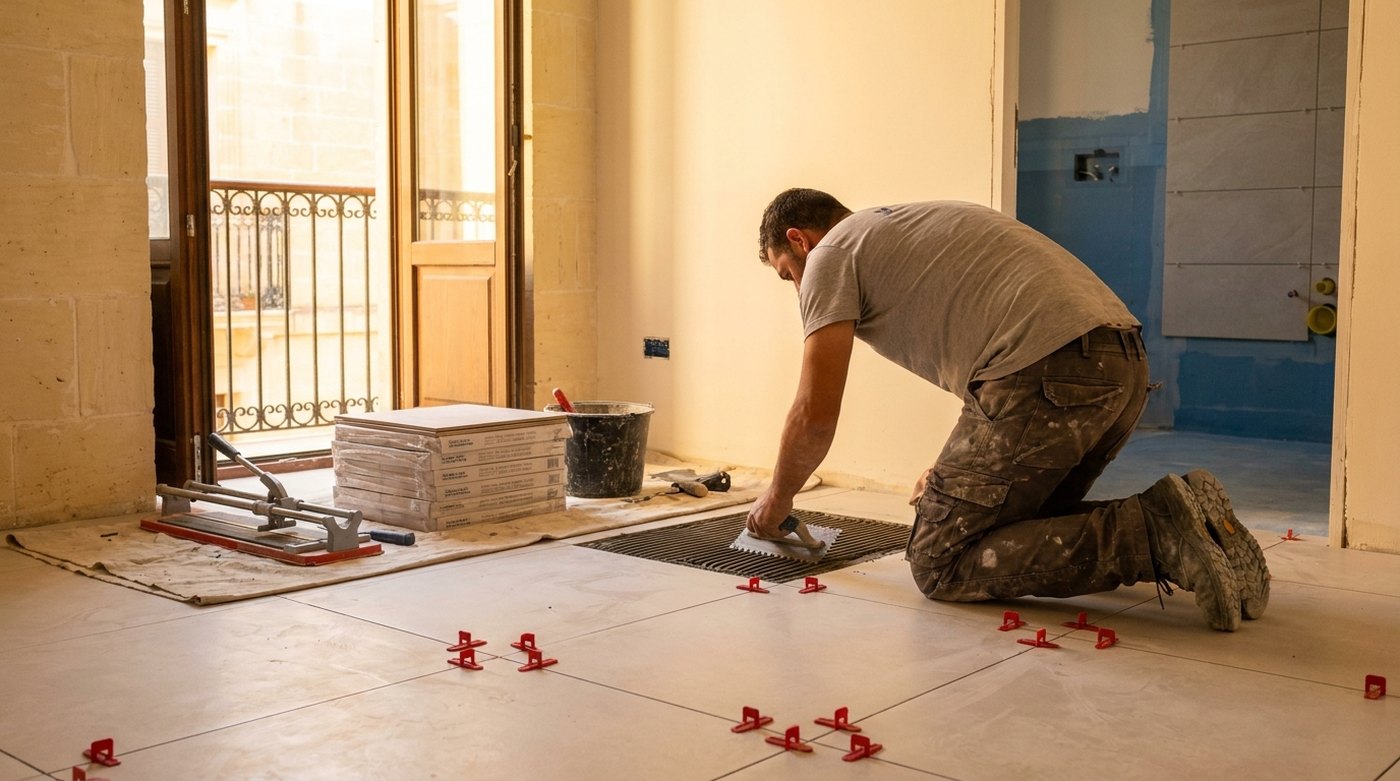
Grout is the cheapest material in a tiling job and the first one to fail. It is also the part most buyers never ask about until a shower starts going black along the bottom course. This page sets out what the codes on a Maltese bag mean, what the bags cost, and what a regrout actually involves.
The codes on the bag
EN 13888 is the European standard for grout, and it is the same standard whether the bag was bought in Msida or Manchester. The lettering is short:
- CG — cementitious grout. Class 1 is standard, class 2 is improved.
- W — reduced water absorption.
- A — high abrasion resistance.
- RG — reaction-resin grout, meaning epoxy or polyurethane. Chemically resistant and waterproof.
So a bag marked CG2 WA is an improved cement grout that both absorbs less water and takes more wear than the baseline. A bag marked RG is a different material entirely, not a better version of the same one.
For a domestic bathroom, a CG2 W grout with an anti-mould additive is usually adequate. That is the honest position and it is worth knowing before a showroom talks you into epoxy for a guest en suite.
A real product, read properly
Kerakoll Fugabella Color is a resin-cement grout classed CG2 WA under EN 13888 (ISO 13007-3). The manufacturer's data gives joints of 0–20 mm, and use on interior and exterior floors and walls — including swimming pools and underfloor heating. At 28 days: flexural strength ≥2.5 N/mm², compressive strength ≥15 N/mm², water absorption ≤2 g at 30 minutes and ≤5 g at 240 minutes, abrasion ≤1000 mm³, shrinkage ≤3 mm/m.
Two of those numbers matter to a Maltese reader more than the rest. The 0–20 mm joint range covers almost anything you will do in a Maltese flat, including the wide joints people use on rustic terrace tiles. And the application temperature range is +5 to +30 °C. That is an air and substrate figure, and on an exposed terrace in July the substrate is the problem, not the air. Grouting outdoors in high summer is an early-morning job or it is a job for another month.
Joint width decides the product
UK trade guidance divides grout by joint width: up to 3 mm, unsanded; 3–10 mm, sanded; over 10 mm, a wide-joint product. Some products, Fugabella among them, span the whole range in one bag, but not all do. The Iperceramica listing does not state joint widths for anything it sells, so check the sack or the technical sheet before you buy. If you are matching a regrout to existing joints, measure the joint first.
What grout costs in Malta
Prices as listed by Iperceramica (Msida):
| Product | Pack | Price |
|---|---|---|
| Kerakoll Fugabella Color (cement-based, about 50 colour codes) | 3 kg | €14.29–17.59 a pack |
| Kerakoll Fugarok | 20 kg | €35.09 |
| Kerakoll Fugalite Color (epoxy) | 1.5 kg | €24.48–49.39 a pack |
The shape of that table is the whole argument. Cement grout comes in 3 kg packs at mid-teens euro. Epoxy comes in packs half that size at up to €49.39. UK trade guidance puts epoxy at three to five times the cost of cement grout, and the Maltese shelf prices are consistent with that.
Note that the listing does not give coverage figures, so you cannot turn these prices into a cost per square metre without the technical sheet. Colour choice is wide — about 50 codes for Fugabella Color — which matters if you are matching a partial regrout rather than doing a whole room.
When epoxy earns its price
Epoxy is the right answer in a defined and fairly short list of places: swimming pools, commercial kitchens, food-preparation counters and steam rooms. The common thread is standing water, aggressive cleaning chemicals or hygiene requirements that a cement joint cannot meet.
In Malta that list has one addition most British buyers do not expect: pools are common here in a way they are not at home, and a lot of them are private. If you are tiling a pool, epoxy is not a luxury specification. A kitchen worktop tiled in porcelain with a grouted joint is the other obvious case — that joint is a food surface.
What epoxy does not fix is a bathroom that was built wrong. If water is getting behind the tiles because a wet room was never tanked, or because a terrace above was never waterproofed under the screed, epoxy grout on the surface will delay the symptom and not the cause.
Regrouting: what the job is
Regrouting is not scraping the surface and smearing new grout over it. The joint has to be raked out to a reasonable depth, the bed cleaned, the new grout worked in, and the silicone renewed at every internal corner and at the junction with the tray, bath or floor. Those corners are movement joints and they must be silicone, not grout, or they will crack again.
While the joints are open, the tiler can see what is behind them. In Maltese flats the common findings are hollow-sounding tiles over a screed that debonded, and a wet patch at the bottom of a shower wall that means the problem is the tanking. Replacing cracked or lifted tiles found along the way is a separate line and is also quoted on site.
Timing: UK trade guidance gives 24 hours to light traffic and 7 days to full cure. Plan the bathroom to be out of use for the first day and treat the first week gently.
What a regrout costs here
No Maltese tiler publishes a regrouting rate, and this site does not either. On the Tiler.mt rate card, Regrouting — rake out and regrout, silicone renewed carries no price band at all: unit is per square metre, quoted on site. The reason is that the variables — joint depth, how hard the old grout fights, what is found behind it — swing the labour more than the area does. A first visit to look at a small job falls under the small-jobs call-out at €35–50 per hour, one-hour minimum.
The only per-square-metre figures that exist are British. They are reproduced here as a sanity check on order of magnitude, nothing more:
| Job (UK figures only) | MyJobQuote 2026 |
|---|---|
| Regrouting | £20–35 per m² |
| Removing old grout | adds £20–40 per m² |
| Whole bathroom | £215–285 (average £250), 1–2 days |
| Shower only | £120–250 |
| Floor tiles only | £80–180 |
Do not treat those as Maltese prices. They are shown so that a quote of a wholly different order prompts a question.
Malta-specific points
Floor-to-ceiling tiling means more joint. A Maltese bathroom tiled to the ceiling, which is the norm here rather than the exception, has far more linear metres of grout than the half-tiled British bathroom you may be picturing. A regrout is correspondingly bigger than it looks.
Apartments. If the work touches common parts, condominium rules under Cap. 398 apply, and that includes the obvious case where a regrout turns into an investigation of a leak reaching the flat below. Agree access and responsibility before anyone starts raking.
Gozo. Every bag crosses on the ferry. Grout is a small part of a materials order but it is the part people forget, and running out of a specific colour code mid-job costs a day, not an hour.
Shell form. A property bought in shell has no grout in it because it has no tiles. Grout specification belongs in the first-fit conversation, with the tanking and the waterproofing — not in a phone call three years later.
Trade licensing. There is no trade licence for tilers in Malta. Specifying the grout class in writing, on the quote, is one of the few checks a buyer actually has.
Common questions
- Do I need epoxy grout in my bathroom?
- Usually not. For a domestic bathroom an improved cement grout to CG2 W — class 2, reduced water absorption — with an anti-mould additive is normally adequate. Epoxy, the RG class under EN 13888, earns its price in swimming pools, commercial kitchens, food-preparation counters and steam rooms, and it costs three to five times as much as cement grout.
- What do CG2 and W mean on the bag?
- Under EN 13888, CG means cementitious grout; class 1 is standard and class 2 is improved. W means reduced water absorption and A means high abrasion resistance, so a bag marked CG2 WA is an improved cement grout with both. RG is a reaction-resin grout — epoxy or polyurethane — which is chemically resistant and waterproof.
- How much does regrouting a shower cost in Malta?
- No Maltese contractor publishes a per-square-metre regrouting rate, and this site does not either: rake out, regrout and silicone renewal is priced on site, per square metre. For scale only, UK figures put regrouting at £20–35 per m², with old-grout removal adding £20–40 per m², and a shower-only job at £120–250. Those are UK prices and are not a quote for Malta.
- How soon can I use the shower after regrouting?
- UK trade guidance gives 24 hours to light traffic and 7 days to full cure. Treat the 7 days as the point at which the joint is doing its job, not the first day.
What we could not establish
- The Iperceramica listing does not state joint widths for any of the grouts it sells, nor coverage (how many square metres a 3 kg or 1.5 kg pack fills), so you cannot work out a materials cost per m² from the published prices alone.
- The listing does not state the EN 13888 class of Kerakoll Fugarok, the 20 kg product — the sources establish the price and pack size only.
- No Maltese source publishes a regrouting rate, per square metre or per bathroom. The only per-m² figures available are UK ones.
- No source here covers grout colour fading, efflorescence or sealing practice in Maltese conditions, or whether anti-mould additives are stocked locally.
- Nothing in these sources addresses grout for external terraces exposed to Maltese summer surface temperatures beyond the manufacturer's stated application range.
Sources
- Tiles grouts — Iperceramica (Msida) · read 2026-10-05
- Fugabella Color — NBS Source (UK) — Kerakoll product data · read 2026-10-05
- Grout types and selection — squote (UK) · read 2026-10-05
- Regrouting Cost Guide 2026 — MyJobQuote (UK) · read 2026-10-05
- Tiler.mt rate card — Tiler.mt (first-party) · read 2026-10-05
Drafted with Claude — claude-opus-5, then read, corrected and approved by Neil Bennett before publication. We do not publish anything a person has not read.
Want this costed properly?
The calculator gives you a figure in a minute. A site visit gives you a fixed price.
Book a free survey