
What tile strip-out and waste disposal cost in Malta
Lifting old tiles, bagging the rubble and getting it to a licensed tip is the line most homeowners forget to budget for. Here is the per-square-metre band, what the 2026 construction-waste tipping cap actually caps, and the site rules that govern a skip outside your door.
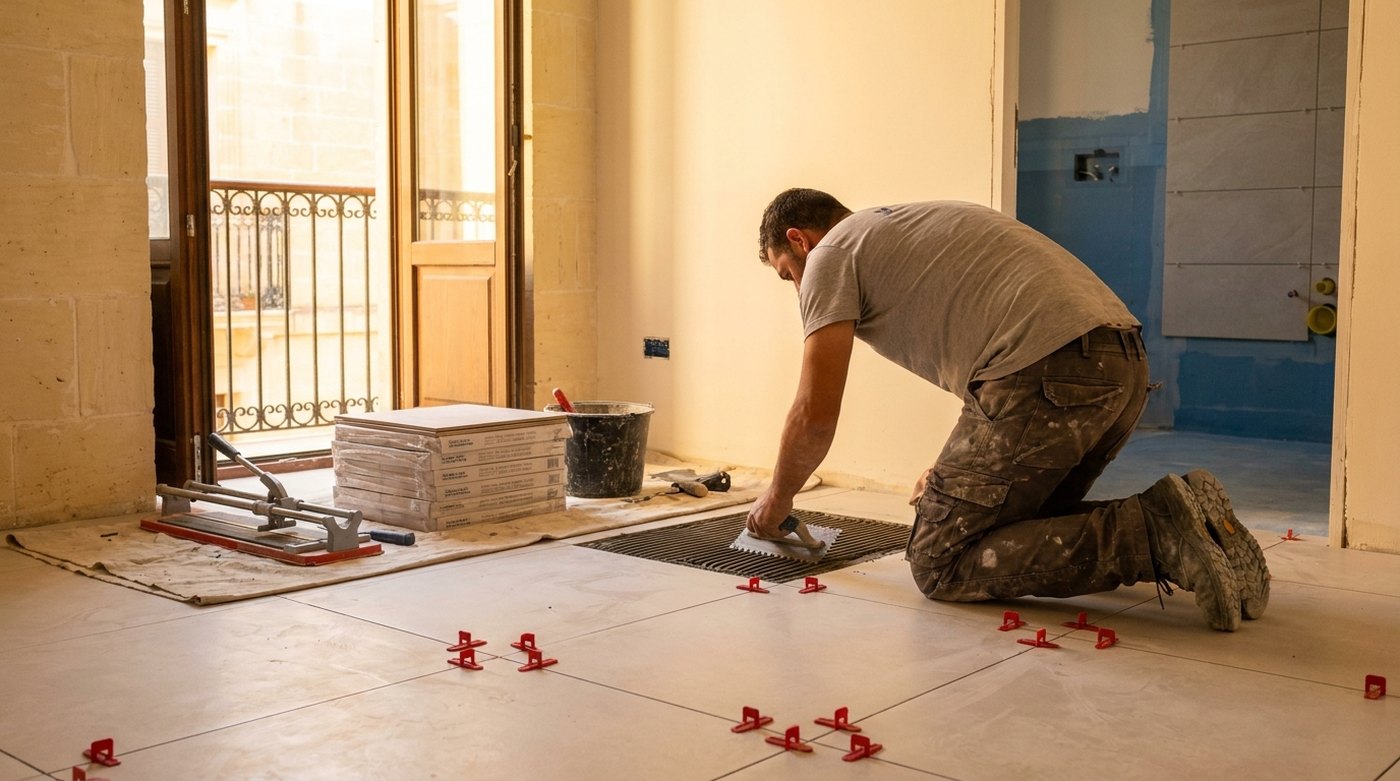
Most retiling quotes a homeowner in Malta reads are really two jobs priced as one. There is the new tiling, which is the part people compare. And there is the demolition that has to happen first: breaking out what is there, filling bags with it, carrying them out of the property and paying somebody to take them to a licensed disposal site. Buyers arriving from the UK often expect the second part to be a modest add-on, because at home a timber floor gets lifted rather than smashed. Here you are usually chiselling tile off a cement bed laid on a concrete slab, and the bed does not want to let go.
The band
Our rate card prices it as follows.
| Line | Band | Unit |
|---|---|---|
| Strip-out of existing tiles | €10–18 | per m² of tiled surface |
| Ceramic / porcelain laying | €35–58 | per m² of tiled surface |
| Floor levelling compound | quoted on site | — |
| Small-jobs call-out | €35–50 | per hour, one-hour minimum |
The strip-out band covers removal, bagging and disposal. Making good is extra where render comes away with the tiles. That caveat does most of the work in practice: on older Maltese walls, and particularly in bathrooms tiled floor to ceiling where the tiles have been on for decades, the render frequently comes off in sheets with the tile still stuck to it. Nobody can tell you from a photograph whether that will happen to you. A tiler can tell you after the first square metre.
Note the unit. Everything on the rate card is priced per square metre of tiled surface, not per square metre of floor area. A bathroom with a 4 m² floor and walls tiled to the ceiling can easily have three or four times as much tiled surface as floor, and all of it has to come off and be carried out.
For context rather than comparison: a UK cost guide puts tile removal at £15–20 per hour and floor screeding at around £250 for an unspecified area. Those are British labour rates for British construction and do not translate to a Maltese concrete substrate. They are useful only as a reminder that strip-out is a real, separately priced trade operation everywhere, not something a tiler throws in.
What changed at the tip in 2026
The disposal end of this got more expensive during 2026, and the change is worth understanding because it is the part of the price that no contractor controls.
In June 2026, The Shift News reported that €12 per tonne was the benchmark fee for construction and demolition waste, that quarry operators were restricting what they would accept, and that around six quarry operators control disposal capacity in Malta. That is a concentrated market, and it behaves like one.
On 4 August 2026, the same outlet reported that a legal notice had raised the maximum fee for disposing of construction and demolition waste from €12 to €16 per tonne — a 33% increase. Quarry owners had asked for €20–22. Three details in that notice matter to anyone paying a bill:
- The cap is defined to include any service, administration or processing fee or surcharge. It is a total, not a headline rate with extras bolted on.
- Operators who exceed the cap, or who refuse waste without justification, lose a tax exemption for that year. Refusing loads was exactly the complaint in June.
- The scheme runs to 2031.
What this is not is a price you pay. It is a ceiling on what a disposal operator may charge whoever turns up at the gate with a truck. In a domestic retile, that is your contractor or a skip operator, and the fee reaches you folded into their price. If a quote presents "€16 per tonne" as a line item on your bathroom, ask how the tonnage was weighed.
That question is harder than it sounds, and we cannot answer it for you. None of our sources establishes how many tonnes of rubble come off a square metre of lifted tile and bedding. Tile thickness, bed thickness and whether the screed comes up with it all change the answer. Anyone who converts the tipping cap into a confident per-square-metre figure is estimating, not citing.
Skips: the price nobody publishes
We looked for a current published Maltese skip price and did not find one. No operator we could find lists rates online.
The only published figure in our source set is historic. On 30 January 2019, MaltaToday reported a skip-hire operator who said he had raised his price from €50 to €120 a skip after Siggiewi quarry fees rose — construction waste from €7 to €12 per tonne and demolition waste from €10 to €15 per tonne, effective 11 February 2019. Treat €120 as a 2019 data point and nothing more. It sits two increases behind the current cap, and the operator who quoted it may no longer be trading at that price or at all.
The practical consequence: get the skip or the haulage priced in writing before anyone swings a hammer, and get it clear whether it is in the tiler's quote or yours to arrange. This is the single most common gap between what a homeowner thinks they bought and what arrives.
What the law says about the rubble on your pavement
The Construction Management Site Regulations (S.L. 623.08, L.N. 340 of 2022 as amended by L.N. 142 of 2023) expressly define "works" to include finishing works. Tiling is finishing works. The regulations are not only for cranes and excavators.
The Fourth Schedule, item 2(a), requires that waste be cleared routinely using fully enclosed receptacles, or open skips securely covered with canvas or similar, and removed from the immediate vicinity every day, unless the site manager justifies an extension to the Building and Construction Authority. An uncovered skip of tile rubble sitting on a street in Sliema for a long weekend is not a grey area.
The Ninth Schedule sets the penalties. Breaches of site cleanliness run €250–1,000, with a further €25 for each day the breach continues. Obstruction of pavements runs €35–250.
Two things follow for a homeowner. First, daily removal is a cost driver: a job that generates rubble over five days generates five removal movements, not one skip at the end. Second, if you are in an apartment, the route the rubble takes down to the street crosses common parts, and that is a conversation to have with the condominium before the first tile comes off — our sources do not settle how those rules interact with the site regulations, and administrators differ.
Afterwards: levelling
Once the old tiles are off, you find out what the substrate looks like. Our rate card deliberately carries no band for floor levelling compound — it is quoted on site, after the floor is exposed and someone has put a straightedge across it. A property bought in shell form may need none at all; a 1970s apartment where three generations of tiles have been laid over each other may need a lot. Any figure given before the strip-out is a guess dressed as a quote.
Budget strip-out at €10–18 per m² of tiled surface, assume disposal is inside that number unless your quote says otherwise, and hold a contingency for making good and levelling. Those are the two lines that genuinely cannot be priced from the doorway.
Common questions
- How much does it cost to remove old tiles in Malta?
- Our rate card prices strip-out of existing tiles at €10–18 per square metre of tiled surface. That band covers breaking out the old tiles, bagging the rubble and disposing of it. Making good is extra where the render or screed comes away with the tiles, which on older Maltese walls is common rather than exceptional.
- Do I pay the €16 per tonne construction waste fee myself?
- Not directly, in a normal domestic retile. The €16 per tonne figure set in August 2026 is a legal maximum on what a disposal operator may charge, up from €12. It is a ceiling on the quarry's price, and it is defined to include any service, administration or processing fee or surcharge on top. It reaches you inside the contractor's or skip operator's price, not as a separate line on your invoice.
- What does a skip cost in Malta?
- No Maltese skip operator we could find publishes a current price list. The only published figure in our sources is historic: in January 2019 MaltaToday reported an operator who had raised his price from €50 to €120 a skip after Siggiewi quarry fees went up. That is a 2019 number, not a 2026 one, and it predates two rounds of tipping increases. Ask for the skip to be priced in writing before work starts.
- Can the skip be left outside my house overnight?
- Under the Construction Management Site Regulations, waste must be cleared routinely using fully enclosed receptacles, or open skips securely covered with canvas or similar, and removed from the immediate vicinity every day unless the site manager justifies an extension to the Building and Construction Authority. Breaches of the site cleanliness rules carry fines of €250–1,000, plus €25 for every day the breach continues; obstructing a pavement carries €35–250.
What we could not establish
- Nobody publishes current Maltese skip-hire prices. The only published figure in our sources is from January 2019 (€120 a skip) and cannot be updated from any source available to us.
- The sources do not establish how many tonnes of rubble a square metre of lifted tile and bedding produces, so the €16 per tonne cap cannot honestly be converted into a per-square-metre cost.
- The August 2026 legal notice number is not given in the reporting, so the instrument cannot be cited directly here.
- The sources do not establish what quarries currently charge in practice, only the legal maximum, nor whether Gozo disposal costs differ from Malta or how rubble is handled on the ferry crossing.
- The sources do not establish whether a tiler, a skip operator or a waste carrier needs any particular licence or permit in Malta, nor how condominium common parts under Cap. 398 affect carrying rubble down a shared staircase.
- The sources do not price making good where render comes away with the tiles, nor floor levelling compound — both are quoted on site.
Sources
- Tiler.mt rate card — Tiler.mt (first-party) · read 2026-10-05
- Abela bows to developers owning quarries, increases dumping costs by 33% for their benefit — The Shift News · read 2026-10-05
- Construction waste dispute threatens to further increase property prices — The Shift News · read 2026-10-05
- Exorbitant hike in fees for construction waste disposal could impact property prices — MaltaToday · read 2026-10-05
- S.L. 623.08 Construction Management Site Regulations (L.N. 340 of 2022, as amended by L.N. 142 of 2023) — Leġiżlazzjoni Malta · read 2026-10-05
- Floor Tiling Cost Guide 2026 — MyJobQuote (UK) · read 2026-10-05
Drafted with Claude — claude-opus-5, then read, corrected and approved by Neil Bennett before publication. We do not publish anything a person has not read.
Want this costed properly?
The calculator gives you a figure in a minute. A site visit gives you a fixed price.
Book a free survey