
Tiling a Maltese flat: work hours, noise and neighbours
Tiling is a finishing work under S.L. 623.08, so the construction noise hours apply to it in full. The Condominium Act then decides who pays for the slab under your tiles and what you may not do to it.
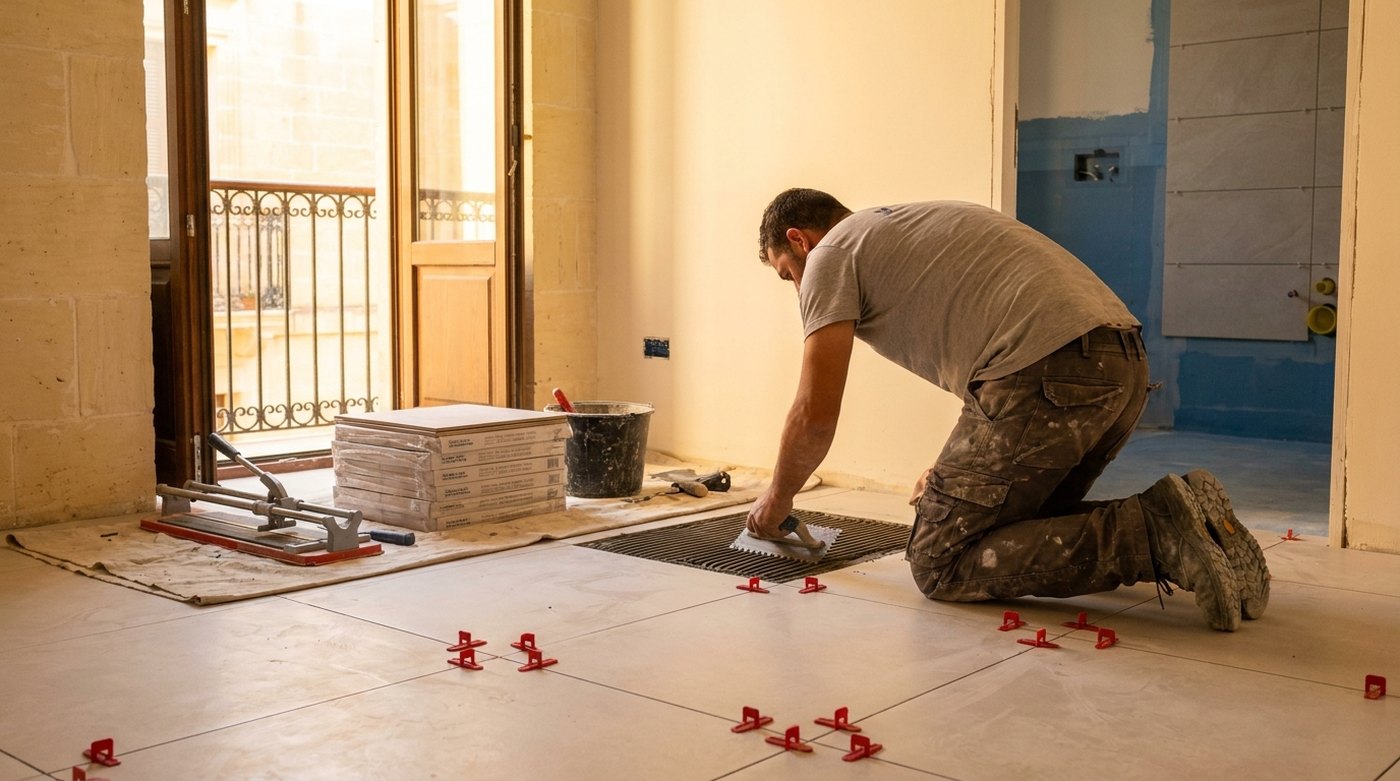
Most of the friction in a flat refurbishment is not technical. It is the neighbour on the floor below, the administrator of the block, and the question of whether anyone is allowed to run a breaker at half past seven on a Saturday morning. Two instruments govern this: the Construction Management Site Regulations, S.L. 623.08, which control when noise may be made, and the Condominium Act, Cap. 398, which controls what you may do to the structure and who pays for it.
Tiling is covered by the construction regulations
Readers arriving from the UK often assume that a one-room retile is domestic work outside any construction regime. It is not. Regulation 3 of S.L. 623.08 defines "works" to include excavation, demolition, construction, building services and finishing works. Tiling is a finishing work. Stripping an old bathroom back to the blockwork, chasing for a new waste, screeding a floor, laying porcelain — all of it falls inside the regulations, and so do the hour limits attached to them.
That matters more in Malta than it would elsewhere, because the substrate here is concrete and screed rather than timber. Removing an existing tiled floor means percussive work transmitted directly through a slab shared with the flat below. There is no floor void to absorb it.
The hours
The relevant provisions are in the Third Schedule, item 1. They are triggered by noise audible outside the site — and in an apartment, the site is your flat, so in practice almost everything is audible outside it.
| Activity | Earliest start | Latest finish | Sundays and public holidays |
|---|---|---|---|
| Construction works generally | — | — | Not permitted |
| Noise audible outside the site | 7:00 am | 8:00 pm | Not permitted |
| Excavator with hydraulic hammer, or pneumatic drill | 7:30 am | 4:00 pm | Not permitted |
Saturday is not treated separately. The Fourth Schedule adds a conduct layer that is easy to forget and easy to get reported for: avoid leaving machinery idling, avoid shouting, avoid loud radios on site. A compressor left running on a shared landing or a radio at volume in a stairwell is its own breach, independent of the hours.
There are three releases from the timing rules. Emergencies are permitted, provided the Building and Construction Authority is informed within its first business hour. Exemptions otherwise require BCA approval. And the rules are lifted entirely where the nearest habitable space is more than one kilometre away — a provision that will never apply to a flat in Sliema, Gżira or Victoria.
The 14:00–16:00 break is not in the text
A two-hour afternoon prohibition, usually quoted as 14:00 to 16:00, circulates widely in Maltese property conversation and in building-block notices. It does not appear in the consolidated text of S.L. 623.08 as published on legislation.mt. The Third Schedule sets a 7:00 am to 8:00 pm envelope and a 7:30 am to 4:00 pm window for pneumatic drills and hydraulic hammers, and nothing between.
This cuts both ways. A contractor who stops for two hours is not complying with anything, and a neighbour who demands silence after lunch is not citing the regulations. But the drill cut-off at 4:00 pm is real, and it is earlier than most people expect.
Summer bans in tourism zones: demolition and excavation only
Each year the BCA, coordinating with the Malta Tourism Authority, designates streets in tourism areas where demolition and excavation are prohibited from 15 June to 30 September. The 2026 list was announced in June, with the streets published on the MTA website and breaches reportable on 138.
The ban is confined to demolition and excavation. Tiling, as a finishing work, is not caught by it, and neither is the rest of a normal internal refurbishment. The daily hour limits in the Third Schedule continue to apply through the summer regardless. Where the sources stop being clear is at the margin: whether taking up an old floor with a handheld breaker is "demolition" for this purpose is not resolved by anything published, and in a listed street during the summer that is a question worth putting to the BCA rather than guessing at.
Penalties, and who is deemed responsible
The Ninth Schedule attaches fines:
- Works on a Sunday or public holiday, or outside permitted hours: €500–2,500
- Drill or excavator used outside its permitted hours: €250–1,000
- Excessive noise: €250–1,500
The provision owners tend to miss is regulation 8(5): where no site manager has been nominated, the client is deemed to be the site manager. If you engage a tiler for a flat refurbishment and nobody is formally nominated, the exposure runs to you, not only to the tradesman holding the breaker. This is worth settling in writing before the first day.
The Condominium Act: your floor is someone else's ceiling
Article 10 of Cap. 398 is short and consequential: no condominus may carry out works in his own property that may cause damage to the common parts. In a Maltese block that is not an abstract restriction. Chasing deeply into a dividing slab for underfloor services, cutting into a party wall for a shower niche, or overloading a terrace with a thick new build-up are all works inside your own unit that act on structure which is not exclusively yours.
Article 11(1) sets the default for common-part costs: shared in proportion to the value of each unit, unless agreed otherwise.
Article 12 then deals specifically with the structure between two flats, where the ceiling is a common part and the floor of the unit above:
- Maintenance and repairs of that structure: one half the lower owner, one half the upper owner (art. 12(1))
- Laying the floor paving: all costs borne by the upper owner (art. 12(2))
- Painting and decorating the ceiling: the lower owner (art. 12(3))
So your new porcelain floor is yours to pay for in full. The slab it sits on is shared. Two qualifications matter. Article 12 is not mandatory — owners may agree a different split. And where the damage was caused by one owner's negligence, that owner bears the whole repair cost, not half of it. A water escape from a badly detailed shower tray that stains the ceiling below is the clearest example of how a 50/50 rule becomes a 100/0 one.
No impact-sound rule exists
Buyers from northern Europe often ask which acoustic underlay is required under tiles in a flat. Nothing in the sources consulted sets an impact-sound standard for a floor between dwellings in Malta. S.L. 623.08 governs noise during the works; the Condominium Act governs cost and damage. The silence of the law is not an argument for ignoring the issue — a hard tiled floor over a bare concrete slab transmits footfall straight into the flat below, and the complaint that follows will be a civil matter between neighbours rather than a regulatory one. It simply means the decision is yours, not a code's.
Scheduling a flat job against these limits
The practical consequence is that percussive demolition — lifting old tiles and screed — has a seven-and-a-half-hour working day at most, 7:30 am to 4:00 pm, six days a week. Quieter stages, laying, grouting, silicone, can run to 8:00 pm but not on a Sunday or public holiday. On Gozo, where every material delivery crosses on the ferry, a strip-out day lost to a Sunday or a breaker cut-off is harder to recover than in Malta.
Estimates priced per square metre of tiled surface describe the work, not the calendar. The calendar is set by the Third Schedule.
Common questions
- Can tilers work on a Saturday in Malta?
- Yes. The Third Schedule of S.L. 623.08 bans construction works on Sundays and public holidays, and bans pneumatic drills and hydraulic hammers on those days too. Saturday is not singled out, so the ordinary limits apply: nothing audible outside the site before 7:00 am or after 8:00 pm, and no drill or hydraulic hammer before 7:30 am or after 4:00 pm.
- Does the summer construction ban stop me retiling a bathroom in July?
- No. The 15 June to 30 September restriction in tourism zones covers demolition and excavation. Tiling is a finishing work, and the street lists published for 2026 by the BCA and the Malta Tourism Authority address demolition and excavation only. The ordinary daily hour limits still apply throughout the summer.
- Is there an official 14:00 to 16:00 afternoon quiet period for construction?
- Not in the current text of S.L. 623.08. The Third Schedule sets a 7:00 am to 8:00 pm envelope for audible noise and a 7:30 am to 4:00 pm window for pneumatic drills and hydraulic hammers. No midday or early-afternoon break appears in the regulations as consolidated on legislation.mt.
- Who pays for retiling the floor between two flats?
- Under article 12 of the Condominium Act, the upper owner bears all the costs of laying the floor paving, the lower owner pays for painting and decorating the ceiling, and maintenance and repairs of the dividing structure itself are split one half each. Article 12 is not mandatory, so owners can agree otherwise, and where one owner's negligence caused the damage that owner bears the whole repair cost.
- Must floor tiles between flats meet an impact-sound standard in Malta?
- None of the sources used here establishes any such standard. S.L. 623.08 regulates noise from the works while they are being carried out, not the acoustic performance of the finished floor, and the Condominium Act deals with costs and damage rather than sound insulation.
What we could not establish
- No source consulted sets an impact-sound or acoustic-insulation standard for a tiled floor between two flats, nor any requirement for resilient underlay.
- The sources do not say whether lifting an old tiled floor or screed with a handheld breaker counts as 'demolition' for the purposes of the 15 June to 30 September tourism-zone ban, or only as finishing work.
- No source consulted lists which days count as public holidays for the Third Schedule.
- Nothing in the sources requires an owner to notify neighbours or the condominium administrator before starting internal works, or sets a notice period.
- The sources do not establish whether a condominium deed or regulations may impose working hours stricter than S.L. 623.08, or how such a rule would be enforced.
- No source consulted establishes any trade licence, registration or qualification requirement for tilers in Malta.
- No source consulted gives a decibel limit for construction noise; the Third Schedule works on timing and audibility, not measured levels.
Sources
- S.L. 623.08 Construction Management Site Regulations (L.N. 340 of 2022, as amended by L.N. 142 of 2023) — Leġiżlazzjoni Malta · read 2026-10-05
- Check out in which streets excavation, demolition is prohibited during summer — MaltaToday · read 2026-10-05
- Condominium Act (Cap. 398) — Leġiżlazzjoni Malta · read 2026-10-05
- The Maintenance of Roofs, Floors & Ceilings under Maltese Law — Mamo TCV Advocates · read 2026-10-05
Drafted with Claude — claude-opus-5, then read, corrected and approved by Neil Bennett before publication. We do not publish anything a person has not read.
Want this costed properly?
The calculator gives you a figure in a minute. A site visit gives you a fixed price.
Book a free survey